

If you’ve been searching for advice on tree pruning, you’ve probably found a lot of conflicting information out there. Some of it suggests you can grab a saw and do it yourself on a Sunday afternoon. Some of it makes the whole thing sound impossibly complicated. The reality, as with most things, sits somewhere in the middle.
The most important part isn’t the cutting itself, it’s understanding why, when, and how much.
This guide is written to walk you through our approach to professional tree pruning. It’s not a DIY manual, and tree pruning done incorrectly can seriously harm the tree, create structural hazards, or even land you in legal trouble if the tree is protected. What it is, we hope, is a clear and honest explanation of how we work, what we look for, and why the details matter.
How to prune a tree and what the process involves
Professional tree pruning is a structured process that begins with assessment. Before any branch is removed, a qualified arborist evaluates the tree’s species, health, structure, proximity to buildings or power lines, and any legal protections that may apply. The goal is always to improve the tree’s long-term health and safety.
When we arrive to carry out tree pruning services, the first thing we do is step back and look at the whole picture, and ask questions like:
- What is the tree trying to do?
- Where is it putting its energy?
- Are there signs of disease, structural weakness, or deadwood?
- Are there co-dominant stems, known as two competing leaders growing at the same rate, that could cause a split further down the line?
- Are there branches rubbing against each other, or suckers emerging from the base that are diverting energy away from the main tree?
Once we understand the tree, we start planning the work.
The key techniques we use for tree pruning include:
- Crown thinning: Selectively removing branches from within the canopy to improve light and airflow without changing the tree’s overall shape.
- Crown lifting: Removing the lower branches to increase clearance above ground, driveways, or structures beneath the tree.
- Crown reduction: Reducing the overall height or spread of the canopy, carried out to BS3998 (the British Standard for tree work), to ensure the cuts are made correctly.
- Deadwooding: Removing dead, dying, or diseased branches that could fall and cause injury or damage.
- Formative pruning: Shaping younger trees during their early years to encourage a strong, balanced structure.
All cuts are made to the natural branch collar, which you’ll recognise as the slightly raised ring of bark at the base of each branch. Cutting here allows the tree to seal over the wound efficiently, forming a callus of new tissue that’s essential to the tree’s recovery.
For larger branches, proper technique involves three cuts rather than one. A single cut on a heavy branch risks tearing the bark back down the trunk as the weight drops. Instead, we make an initial relief cut on the underside of the branch first, then a second cut from the top to remove the bulk of the weight, and a final precise cut at the branch collar.
When to prune trees in the UK
Quick Answer: Most tree pruning in the UK can be carried out year-round, but the optimal timing depends on the species, the type of work needed, and the time of year. Winter (November to February) is generally ideal for tree care in most deciduous trees, while some species, particularly those susceptible to specific diseases, have stricter seasonal windows.
One of the most common questions we get asked is “when should trees be pruned back?” And the answer is genuinely nuanced, which is why it’s worth getting right.
Tree pruning summary of timing by category:
Tree Type/Situation | Best Pruning Window | Why |
|---|---|---|
Most deciduous trees (oak, ash, beech, etc.) | November to February | Dormant season: lower sap flow, less stress on the tree, easier to see the structure without leaves |
Oaks specifically | Avoid April to June | Reduces risk of Oak Processionary Moth (OPM) and oak wilt during active growth |
Cherries, plums, and other Prunus species | Late June to August | Pruning in winter dramatically increases risk of silver leaf disease and bacterial canker |
Birch and walnuts | Late summer or full dormancy | These varieties bleed heavily if cut in spring; late summer wounds seal more cleanly |
Evergreens (holly, laurel, conifers) | Late spring or early autumn | Avoids frost damage to fresh cuts and allows regrowth before winter |
Hazard removal / deadwood | Any time of year | Safety work is not seasonal, and a dangerous branch needs attention immediately |
There is never a wrong time to remove dead, damaged, or diseased branches because that work is driven by safety, not the calendar. But for routine pruning and shaping, getting the timing right makes a significant difference to how well the tree recovers.
For advice on tree services all year round, or to request a quote for free, speak to our team.
Does pruning change depending on the tree?
Quick Answer: Yes, every species has different growth habits, wound response mechanisms, seasonal vulnerabilities, and structural tendencies. A one-size-fits-all approach to pruning is a common cause of long-term tree damage.
Take oaks and cherries as an example. Both are common in Cheshire gardens and across the county’s hedgerows and parkland, but the pruning approach for each is almost the opposite of the other.
Oaks are best pruned in full dormancy and can tolerate significant crown work without excessive stress. Cherries, on the other hand, are highly susceptible to fungal diseases when cut during dormancy, and wound healing in these trees relies on active growth to seal cuts before pathogens can enter.
The same principle applies across the board. Conifers, deciduous ornamentals, fruit trees, fast-growing species near buildings or watercourses, as each one has its own timing, its own tolerance for pruning, and its own vulnerabilities.
When we assess a tree, identifying the species correctly is the first step in everything that follows. It’s what allows us to make the right recommendations rather than simply doing what’s easiest or most obvious.

Why professional experience is important for tree pruning services
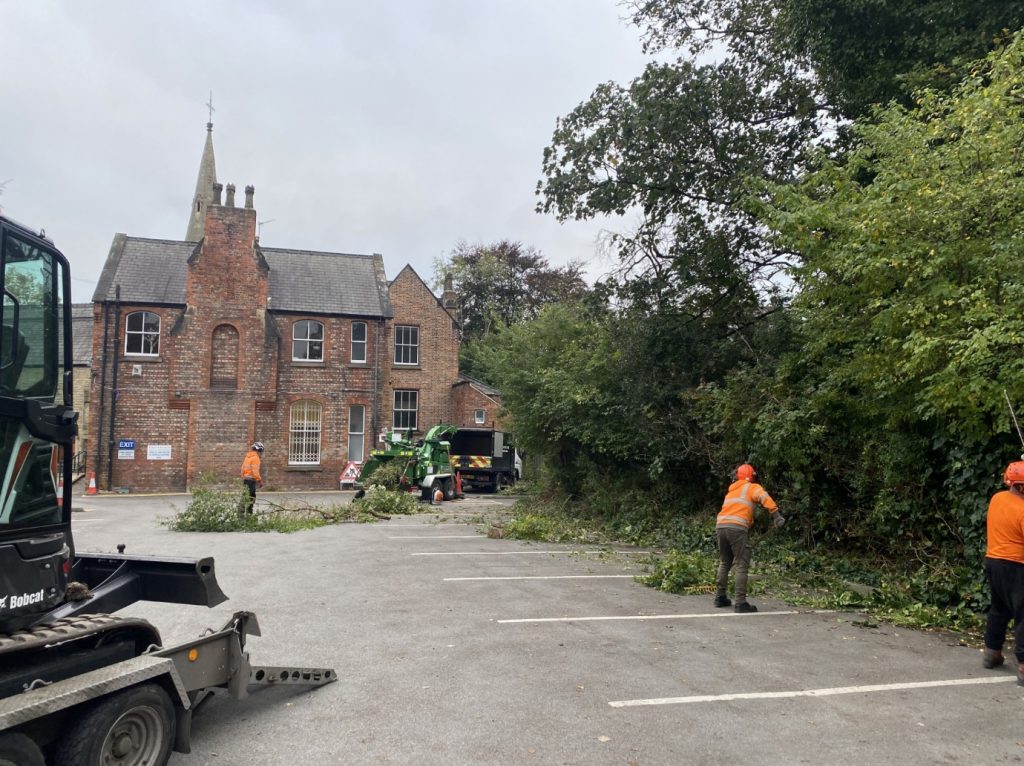
Professional tree pruning involves working at height with chainsaws, often adjacent to structures, roads, or power lines. It requires a combination of arboricultural knowledge, climbing or aerial platform skills, and formal qualifications, including NPTC (National Proficiency Tests Council) certification for chainsaw use.
There’s more to safe tree pruning than meets the eye.
- Rigging and lowering techniques are used to control exactly where material falls, protecting your property and anyone nearby.
- Working at height requires appropriate PPE, climbing equipment, and for larger trees, an aerial work platform.
- Where branches are encroaching on power lines, specific protocols apply and coordination with the network operator is often required.
Our team is fully qualified, insured, and happy to walk you through exactly what’s involved before any work starts. Feel free to ask for more information if you have questions.
How to choose a tree pruning company in the UK
Look for a company with qualified arborists, full public liability insurance and membership of a recognised professional body such as the Arboricultural Association or the International Society of Arboriculture (ISA).
Always ask for a written quote and check reviews from local customers.
With so many local tree pruning companies to choose from, it can be difficult to know how to compare them.
Here's what we'd suggest looking for in a team of tree surgeons:
- Check qualifications: Ask whether the team holds NPTC Level 2 certificates for chainsaw use as a minimum, and if any of the staff are qualified arborists
- Ask about insurance: Any reputable tree services company will carry public liability insurance. Ask to see the certificate rather than just a verbal assurance.
- Request a written, itemised quote: A professional company will be able to tell you exactly what work they’re proposing and why, with no vague language that could lead to unexpected costs later.
- Look for local knowledge: A company that works regularly in your area will understand local soil conditions, common species, and any conservation area or TPO considerations that might affect your tree.
- Check if they’ll dispose of the waste. Most professional tree services will remove or chip the material they cut, but it’s worth confirming upfront.
- Read reviews from local customers: Not just star ratings, but actual written feedback about how the team communicated, if they respected the property, and if the work was carried out as quoted.
Get in touch with local tree pruning experts
If you’ve got a tree that needs attention, or if you’re not sure if it does, we’re always happy to take a look. We offer honest, no-obligation assessments and we’ll tell you exactly what we think, even if the answer is ‘leave it alone for now.’
We’re local people who know Cheshire’s trees, conditions, and quirks. Call us on 07766 582598, drop us a message through our website contact form, or reach us on WhatsApp, whatever’s easiest for you. We’ll guide you through the rest.